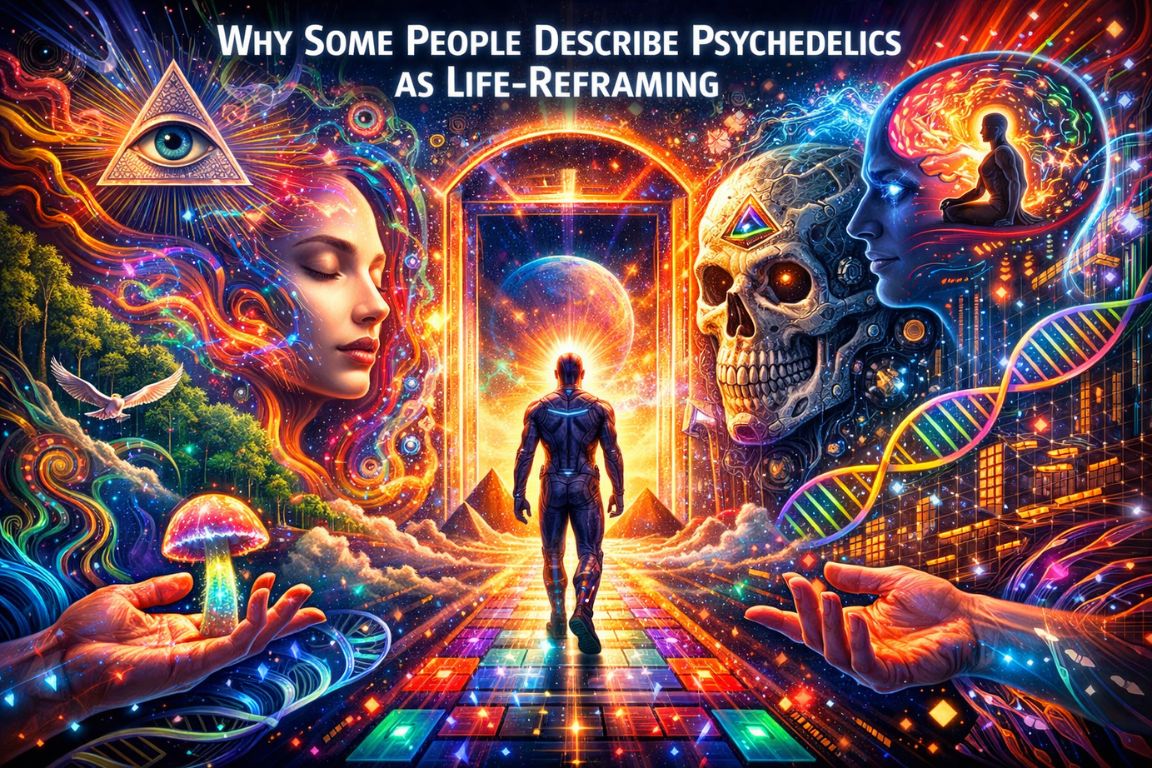
Why Some People Describe Psychedelics as Life-Reframing
When people describe psychedelic experiences, they often avoid simple language. Instead of saying an experience was enjoyable or intense, many use a more specific phrase: life-reframing.
This term is notable because it doesn’t suggest escape, pleasure, or even transformation in the dramatic sense. It suggests something quieter but deeper—a change in how life itself is interpreted.
So why do some people describe psychedelic experiences this way? Psychology and neuroscience offer insight into how reframing occurs, and why it can feel so enduring.
Reframing Is Not Change — It’s Reinterpretation
To reframe something is not to erase it or replace it. It’s to see it through a different lens.
In psychology, reframing refers to changing how experiences are interpreted, not the experiences themselves. The events of life remain the same, but their meaning shifts.
Many people live within stable mental narratives:
- “This is who I am.”
- “This always happens to me.”
- “Things never work out.”
These narratives form over years and become automatic. Psychedelic research suggests that altered states may temporarily loosen the certainty of these interpretations, allowing people to examine them from outside rather than inside.
That shift—from inhabiting a story to observing it—is often what people mean by life-reframing.
The Softening of Mental Absolutes
Everyday thinking relies heavily on certainty. Thoughts often feel definitive, final, and unquestionable. Psychology refers to this as cognitive rigidity—the tendency to treat interpretations as facts.
Under certain altered states, people frequently report that this rigidity softens. Thoughts still arise, but they feel less authoritative. Instead of “this is how it is,” the mind shifts to “this is how I’ve been seeing it.”
This subtle change can be powerful. When beliefs lose their sense of inevitability, alternatives become visible. The future no longer feels locked to the past.
Life isn’t rewritten—but it’s reopened.
Seeing Patterns Instead of Isolated Moments
Another reason experiences feel life-reframing is the shift from fragmented thinking to pattern recognition.
Rather than focusing on single memories or mistakes, people often report seeing:
- How habits formed over time
- How reactions repeat across situations
- How personal narratives developed
This pattern-based awareness changes how individual events are understood. A difficult experience no longer feels random or personal—it becomes part of a larger, understandable story.
When meaning moves from isolated moments to patterns, life feels more coherent. And coherence is deeply reframing.
Emotion and Understanding Align
Lasting insight rarely comes from logic alone. Psychological research shows that insight is most impactful when emotion and cognition align.
Psychedelic experiences are often described as emotionally vivid. This emotional engagement appears to anchor insights more deeply than abstract reasoning ever could.
When an understanding is felt rather than merely thought, it carries weight. It feels personal, relevant, and real. That emotional encoding is why people often describe insights as unforgettable—even when the details fade.
Life feels reframed not because facts changed, but because meaning settled differently.
A More Flexible Sense of Self
Identity plays a central role in how life is interpreted. The way people define themselves—capable or incapable, successful or failing, worthy or unworthy—shapes how every experience is filtered.
Many people describe psychedelic experiences as temporarily loosening rigid identity structures. Instead of being fused with self-concepts, individuals may observe identity as something constructed rather than fixed.
This doesn’t remove the self—it makes it flexible.
When identity becomes flexible, possibility expands. Old definitions no longer feel mandatory. New interpretations of “who I am” become imaginable.
This is one of the most commonly cited reasons experiences feel life-reframing rather than merely interesting.
Distance Without Disconnection
A key aspect of reframing is distance—but not detachment.
Psychologically, distance allows observation. People often report being able to look at thoughts, emotions, or memories without being overwhelmed by them. This distance is not avoidance; it’s perspective.
From this vantage point, emotions can be understood rather than resisted. Memories can be revisited without reliving them. Problems can be examined without immediate self-judgment.
That change in relationship—rather than elimination of difficulty—is what reframes life experience.
Why Reframing Can Last
One of the most striking aspects of life-reframing experiences is that they often persist beyond the altered state itself.
Psychology offers an explanation: once a perspective is genuinely seen, it cannot be unseen. Even if daily habits return, the knowledge that another interpretation exists remains.
With reflection and integration, reframing can influence:
- Decision-making
- Emotional regulation
- Self-talk
- Long-term priorities
The experience opens a door. Integration determines whether someone walks through it.
Reframing Is Not Resolution
Importantly, life-reframing does not mean life becomes easy.
Challenges remain. Emotions still arise. Uncertainty continues. What changes is not the presence of difficulty, but the relationship to it.
People often report:
- Less identification with setbacks
- Greater tolerance for ambiguity
- Increased curiosity rather than fear
Life doesn’t become perfect—it becomes navigable.
What “Life-Reframing” Really Means
When people describe psychedelics as life-reframing, they are rarely claiming instant transformation.
They are describing:
- A widened lens
- A softened narrative
- A more flexible sense of meaning
Life remains complex, but it no longer feels locked into a single interpretation.
That shift—quiet, internal, and deeply personal—is what makes the experience feel so significant.
Conclusion
Psychedelics are often described as life-reframing not because they provide answers, but because they change how questions are held.
By loosening rigid interpretations, aligning emotion with understanding, and creating distance without detachment, these experiences may allow people to see their lives through a broader lens.
The past isn’t erased.
The future isn’t guaranteed.
But the present becomes more open.
And for many, that openness is what makes life feel newly possible.
Available for delivery across Canada only.
🛒 Buy Now
💸 20% off the entire store — no minimum
Promo Code: BLOG20